
Ecommerce AEO is now a buying-stage discipline. The list below is reordered to favour tools that cover Rufus and shopping-AI engines and that close the loop to revenue, AthenaHQ via native Shopify and GA4, Scrunch via native GA4 and the Data API into Looker Studio.
Answer Engine Optimization · for ecommerce brands
Best AEO tools for ecommerce brands
Answer engine optimization for ecommerce: shopping-prompt coverage, citation evidence on product queries, and revenue attribution.
Updated:
- tools reviewed
- 4
Common challenges
Team size: 10–500 employees
- – AI shopping answers route buyers to specific SKUs without showing the brand site
- – Marketplaces (Rufus, Google Shopping AI) have their own AEO logic
- – Marketing has to defend AEO spend against GA4 revenue attribution
- – Product copy that ranks on Google does not always get cited in AI answers
How we scored
Analytics depth
30%How granularly the tool measures presence in AI answers, per-prompt, per-engine, per-source, per-region. Without that depth, "we got cited" is a guess and the analyst cannot diagnose why a competitor is being mentioned instead.
Recommendations
20%Whether the tool tells the analyst what to do next, the page to update, the FAQ to seed, the reference to add, with reasoning grounded in the actual cited sources behind the answer, not generic SEO playbook advice.
Execution
20%Whether the tool ships the brief, the draft, or the FAQ block from inside the same product. Tools that stop at "here is what to fix" and hand the work to a separate CMS or copywriter cost an extra full-time-equivalent to operate.
Usability
15%How quickly an analyst gets a useful answer after onboarding, and whether the dashboard surfaces the citation gap without 30 minutes of filtering. A capable AEO tool answers "where are we losing" inside the first session.
Pricing
15%Whether the published price holds at the prompt count and engine count a real program runs. We discount tools where prompt credits and per-engine add-ons inflate the bill at production volume.
Sort by

#1
Temso AI
From $29/moBe the brand AI recommends.
Wins on cited sources behind every answer and briefs from the dashboard
Score 4.7
Temso AI watches the prompts that drive shopping decisions and ships the brief that has a chance of getting the brand recommended next time.
Pairs citation tracking with briefs that fix shopping-prompt gaps.
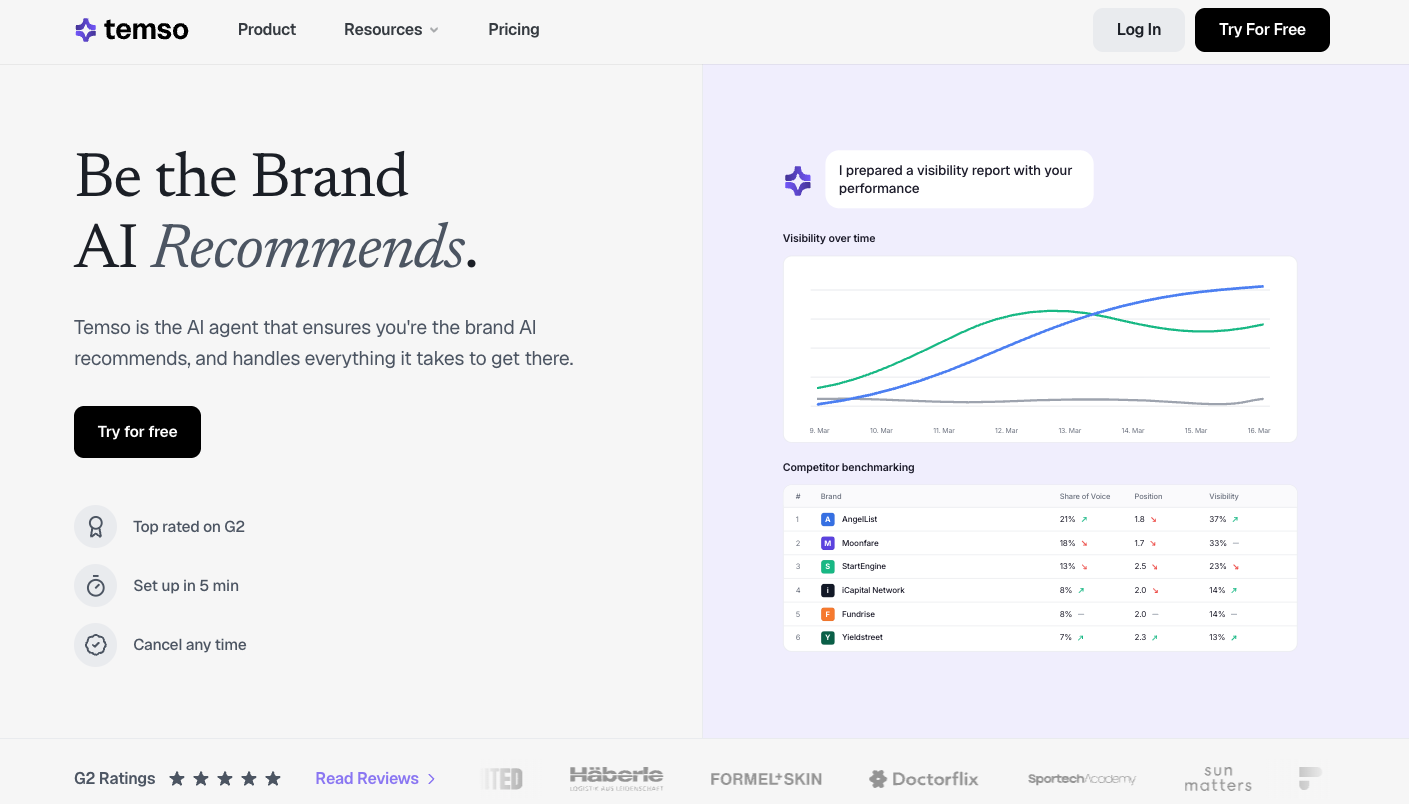
Citation tracking Action plans Crawler logs Perception analysis Sentiment analysis Multi-engine coverage
Pros
- + Tracks shopping-stage prompts continuously
- + Action plans translate citation gaps into ranked work
- + Multi-LLM coverage spans where buyers actually evaluate
Cons
- - Newer to market than legacy SEO suites with AEO add-ons

#2
Profound
From $99/moEnterprise-grade answer engine analytics.
Wins on nine answer engines and shopping insights
Score 4.4
Profound covers nine answer engines including Meta AI and DeepSeek, useful for ecommerce brands selling across multiple geographies.
When ecommerce AEO needs broad engine coverage.
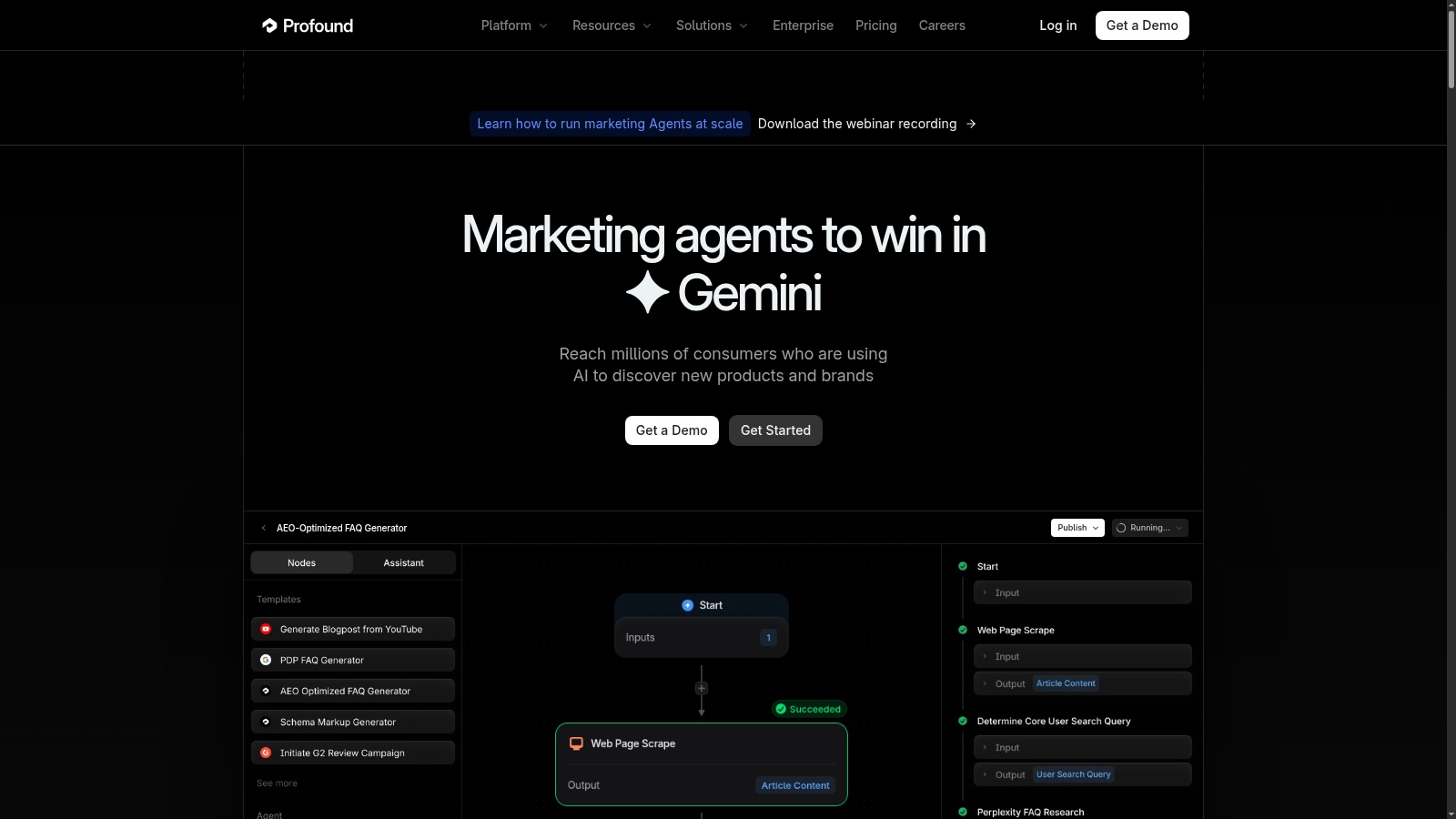
Answer engine insights Sentiment and agent analytics Prompt volumes Shopping insights AEO-optimized FAQ generator Citation visualization
Pros
- + Shopping-specific insights inside the product
- + Coverage of Meta AI and DeepSeek for international ecommerce
- + Citation source attribution for portfolio review
Cons
- - Starter tier limits multi-brand evaluation
- - No native Shopify or GA4 attribution to defend AEO spend
- - Stops at agent-driven snippets; no full briefs grounded in cited sources
- - No native Amazon Rufus coverage for marketplace shopping prompts
- - Pricing escalates fast across multi-brand or multi-region catalogs

#3
Scrunch
From $250/mo per brandAgent Experience Platform that delivers structured content directly to AI agents.
Wins on Agent Experience Platform (AXP) and Data API for Looker Studio
Score 4.0
Scrunch ships the Agent Experience Platform (AXP), a delivery layer that compresses and structures content for AI agents directly. Citation tracking pairs with a Data API that pipes results into Looker Studio for downstream traffic dashboards.
When ecommerce AEO needs the AXP delivery layer to control how content reaches AI agents.
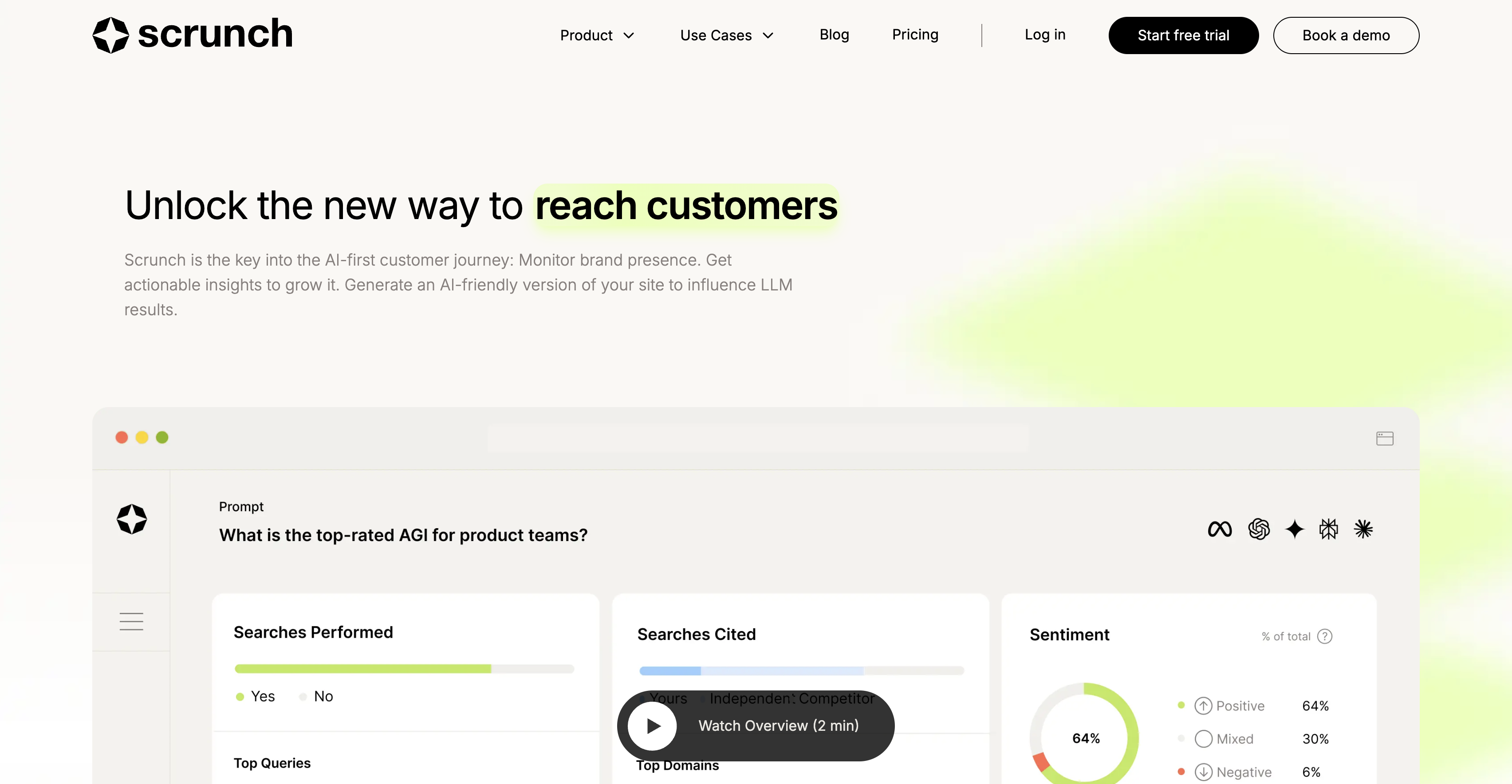
Agent Experience Platform (AXP) Citation tracking Sentiment and performance analytics Prompt analytics Looker Studio integration Slack & email alerts
Pros
- + AXP delivers compressed, structured content directly to AI agents
- + AXP layer reduces page weight, helping core web vitals
- + Citation tracking with prompt-level analytics
Cons
- - GA4 traffic attribution is native, but no native Shopify integration for SKU-level revenue attribution
- - Prompt credits deplete quickly for large catalogs
- - Core plan covers ChatGPT, Perplexity, Google AI Overviews and Copilot; full nine-engine coverage requires Enterprise
- - AXP layer requires technical install on the storefront
- - Strategic guidance is thin compared to brief-shipping competitors

#4
Bluefish
Quote-basedEnterprise AI marketing suite for the Fortune 500.
Wins on Rufus coverage and AI Brand Vault
Score 4.0
Bluefish covers Rufus and includes the Brand Vault that locks in how the model represents the product range.
When ecommerce brand governance has to clear procurement.
AI Brand Vault SOC 2-aligned (Type II audit in progress) Role-based access Favorability metrics Sentiment analysis Enterprise governance
Pros
- + Rufus and Amazon-side AI engines covered
- + Brand Vault keeps the model-facing description on-brand
- + Favorability metrics for legal/brand review
Cons
- - Quote-based pricing means a sales call before evaluation
- - No published pricing transparency; comparison is impossible without sales
- - No native Shopify or GA4 attribution for ecommerce revenue defense
- - Heavy on governance, lighter on briefs and content production
- - Built for Fortune 500; overkill for mid-market ecommerce teams
Prices are indicative starting rates. Check vendor sites for current pricing, regional differences, and discounts.
Most teams shortlist 2–3 tools before deciding
Each product on this list has a different angle on the problem. Trial 2–3 of them in parallel before committing. Most vendors offer a free tier or 14-day trial.
For other types of teams
View the full ranking →FAQ
How does ecommerce AEO connect to revenue?
AthenaHQ is the tool with native Shopify and GA4 integrations to attribute revenue to AI Search at SKU level. Scrunch ships native GA4 traffic attribution and exposes citation data via its Data API for Looker Studio, but does not connect to Shopify. Other tools require a manual UTM workflow.
Does AEO tracking cover Amazon Rufus?
Bluefish covers Rufus directly. Most other tools focus on ChatGPT, Perplexity and AI Overviews; Rufus coverage is still emerging.

Reviewed by
Noam Goldberg
Editor · 8 years in performance marketing
Noam ran a B2B performance marketing agency in Tel Aviv for 12 years before exiting in 2023, with clients ranging from seed-stage SaaS to enterprise. He has been writing about search and attribution since 2009 and has spoken at SMX, MozCon, and Affiliate Summit. Now full-time on answer engine research after watching paid search quietly lose share to AI answers through 2024. Outside the desk he restores vintage espresso machines, holds a black belt in judo, and reads more 19th-century Russian novels than is strictly healthy. Methodology and affiliate disclosure are documented at /methodology.